

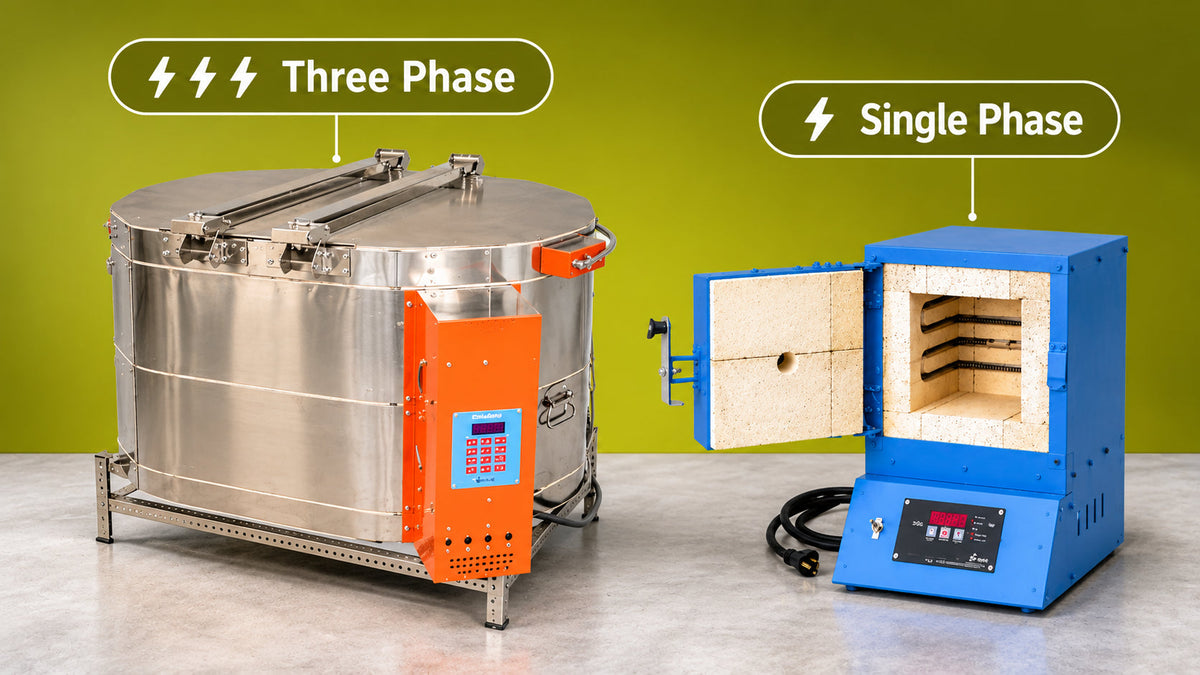
Most U.S. homes have a single-phase service delivering 120/240V power. Many commercial and industrial locations have three-phase service delivering 240V or 208V and, in larger facilities, 480V. Neither wiring system is automatically better for running a kiln. The right kiln is the exact configuration your building can support for voltage, phase, and circuit capacity.
Kiln electrical configurations and availability can vary from manufacturer to manufacturer, and availability can change from one model and ordered option to the next. You cannot assume a kiln comes in both phases, and you cannot treat 208V and 240V as interchangeable. A safe single-phase vs. three-phase power decision requires checking voltage, amperage, circuit, and installation details before ordering.
A rule of thumb is that most residential properties use 120/240V single-phase power, while most commercial properties use 208V single-phase or three-phase power. Most heavy industrial properties use 240V or 480V three-phase power. Of course, this varies by property, and many fall outside these norms.
Key Takeaways: Single-Phase vs Three-Phase Power for Kilns
- Single-phase power fits many home and small-studio kilns, while three-phase configurations appear more often in commercial and industrial facilities or some higher-capacity kiln models, but the building and exact kiln still need a documented electrical match.
- Check the selected kiln’s voltage, phase, amperage, breaker, and connection method because a category label such as “pottery kiln” or “industrial kiln” does not establish electrical compatibility.
- Have a licensed electrician compare the manufacturer’s current requirements with the actual service, panel capacity, circuit distance, receptacle, grounding, and local rules before any new installation or modification.
- Buyers trying to avoid an incompatible order can use Kiln Frog’s Kiln Academy title, The Ultimate Guide to Kilns and Ovens, to prepare better model and site questions about volts, plugs, and outlets before manufacturer documentation and a licensed electrician determine the exact kiln’s electrical requirements.
Single-Phase vs Three-Phase Power for Kilns at a Glance
Single-phase power is the usual starting point for a home kiln. Three-phase can suit facilities and kiln models designed for larger electrical loads. Neither phase is a universal upgrade. Compare kiln options only after confirming what the building can supply and what the exact model requires.
Use the table as a quick filter. It can’t replace the kiln’s current spec sheet. Two models built for the same kind of work may call for different voltage, phase, amperage, or connection methods, so check the ordered option and its nameplate before you commit.
|
Factor |
Single-Phase |
Three-Phase |
What the Buyer Should Check |
|---|---|---|---|
|
Typical building |
Common in U.S. homes and small studios |
Common in many commercial and industrial facilities |
Ask an electrician to identify the site’s actual service |
|
Common kiln context |
Compact kilns and many studio models |
Some large-capacity, commercial, and industrial configurations |
Verify the exact model and ordered option |
|
Voltage examples |
May include 120V, 208V, or 240V, depending on model |
May include several commercial voltages, depending on model |
Match voltage and phase together |
|
Current and conductors |
Requirements vary by kiln and voltage |
Three-phase can distribute a given load across three phases |
Use the manufacturer’s amperage and circuit data |
|
Connection method |
May be plug-in or direct-wired. For models over 50 amps, verify the required connection. |
Larger equipment typically requires direct wiring. Check the exact model. |
Confirm the specified receptacle or hard-wire requirement |
|
Model availability |
Not every model is offered in every voltage |
Three-phase availability depends on whether the manufacturer offers the model in a three-phase configuration. |
Check the current manual, spec sheet, and nameplate |
|
Best next step |
Shortlist models that fit the work and service |
Confirm facility capacity before ordering |
Have a licensed electrician approve installation feasibility |
What Single-Phase and Three-Phase Power Mean
Phase tells you how alternating current reaches the kiln. It says nothing by itself about chamber size, temperature rating, controller quality, or whether the kiln suits your work.
In simple terms, single-phase power uses one alternating voltage waveform (a single leg). Three-phase power uses three waveforms offset by 120 electrical degrees (three legs). U.S. homes are typically served by single-phase power. Commercial and industrial facilities commonly use three-phase service.
Single-Phase Power
Single-phase power is what most residential-studio buyers will encounter. Depending on the exact kiln and ordered option, that can mean 120V, 208V, or 240V service.
Compact 120V kilns can suit test batches, jewelry, metal clay, and small glass projects. Many larger studio kilns use 240V single-phase power. Voltage alone does not settle the choice. The kiln’s amperage, breaker, dedicated circuit, and plug requirements still have to match the site.
A single-phase kiln isn’t necessarily small or lightly powered. Some 240V models still need substantial panel capacity and a dedicated circuit. That’s why the complete manufacturer specification matters more than the phase label on its own.
Three-Phase Power
Three-phase power delivers three alternating waveforms instead of one. You’ll see it more often in facilities built for heavier electrical loads, including some schools, production studios, and industrial shops.
Some higher-capacity kilns are available in three-phase configurations, but the option is model-specific. Olympic Kilns electric-kiln manual, for example, says its studio kilns run on 208V or 240V single phase. Some large-capacity kilns may be ordered in single or three phase. The manual says an Olympic kiln ordered for three-phase power is direct wired.
Three-phase tells you about electrical compatibility, not firing quality. For a glass kiln, phase does not by itself establish faster heating, lower operating cost, or better results. Compare the kiln’s design, elements, insulation, controls, load, voltage, and firing schedule instead.
Which Power Type Fits Home, School, Studio, and Industrial Kilns?
Choose the phase that fits the work and the building’s verified electrical service. Start with the application and capacity you need, then remove any configuration the site can’t support.
For a residential kiln installation, a compact kiln can be a practical starting category. A larger workspace may need to compare 240V kiln options, panel capacity, circuit distance, and installation cost before choosing a model.
Application matters too. Pottery kilns, glass kilns, and heat-treat ovens are built for different processes, chamber shapes, temperatures, and controls. Those labels help narrow the work requirement, but they do not prove phase compatibility.
School buyers choosing a pottery kiln need to consider who will operate it, its location, and whether future programs may need more capacity. Production studios may care more about chamber volume and firing schedules. Those needs shape the shortlist, but the ordered electrical configuration still has to match the facility.
Schools and shared studios may have either single-phase or three-phase service. Verify the site’s actual voltage and phase instead of assuming the building matches residential service. Commercial and industrial buyers should not assume every large-looking kiln needs three-phase power. The exact configuration controls.
Plan Electrical Compatibility Before You Order
Plan the kiln and its electrical installation at the same time, before you commit money or floor space. For commercial kiln installation planning, review industrial kiln options only after defining the application and confirming the building service. Then pick an exact model configuration, collect its electrical data, and have a licensed electrician assess the site.
Give your electrician the exact model number and the current manual or spec sheet, along with the listed voltage, phase, amperage, wattage, breaker requirement, and plug or direct-wire method. Add the intended location, panel capacity, circuit distance, grounding details, and any future equipment you expect to install.
Kiln voltage requirements, kiln amperage, and power need to be read together. Voltage is the supply the kiln is designed to receive, amperage is the current it draws, and wattage describes electrical power when the manufacturer lists it. Matching voltage isn’t enough if the panel, breaker, or circuit can’t support the load.
A dedicated kiln circuit supplies only the kiln, with no other outlets or equipment sharing that branch. The current manufacturer documentation and local requirements determine whether a model needs one and how it must be configured. Leave the calculations and installation to a licensed electrician.
Connection details deserve the same attention. Some kilns use a specified plug and receptacle. A hard-wired kiln connects without a plug and receptacle. Skip extension cords, improvised adapters, assumed conversions, and receptacle changes. Give the electrician the exact connection requirement before site work begins.
Match the Exact Kiln Model to the Available Service
A kiln or heat-treat oven’s exact model and ordered option matter as much as its category. Evenheat states that the Studio Pro 17 is produced only as a single-phase design. Several voltage versions can be built by request, but each remains single-phase. That is a useful reminder that voltage choices do not automatically create a three-phase option.
Do not treat 208V and 240V as interchangeable. Cress warns that a 208V kiln should not be used on 220V or 240V power. Never assume a phase or voltage conversion is possible. Ask the manufacturer about the exact model, then have a licensed electrician evaluate the proposed installation.
Bring a Complete Checklist to a Licensed Electrician
A complete information packet gives the electrician something concrete to check against the actual building. It reveals questions that a product category page can’t answer.
Kiln Frog helps buyers turn the work they want to do into a shorter list of electric kilns, then compare that shortlist by application, voltage, and available model details. This gives the electrician exact model numbers and manufacturer specifications to assess, but Kiln Frog does not approve wiring or act as the installer. Kiln Academy’s The Ultimate Guide to Kilns and Ovens is useful here because it explains electrical terms and selection topics, including volts, plugs, and outlets, that help buyers build a sharper question list.
Use the guide to learn the terminology and build a sharper question list. A current manufacturer document and a licensed electrician still decide whether a specific kiln can be installed at your site.
Practical FAQs About Kiln Power
Kiln power questions come down to matching the exact kiln configuration to the building and involving a licensed electrician before electrical work.
Do I Need Three-Phase Power for a Kiln?
No, most home and studio kilns run on single-phase power. Three-phase matters only when the facility requires it and the exact kiln is offered in a compatible three-phase configuration. Choose for application, capacity, and documented electrical fit instead of assuming three-phase is the upgrade. Think of three-phase wiring as an existing site condition.
Can a Single-Phase Kiln Be Used in a Building With Three-Phase Service?
A single-phase kiln can sometimes operate in a building with three-phase service, but an electrician must confirm that the building can provide the kiln’s required supply. Share the model documentation and the building’s service details. This is a site-design question, so don’t improvise the connection.
Is a 208V Kiln the Same as a 240V Kiln?
A 208V kiln is not the same as a 240V kiln. Do not assume compatibility in either direction. Confirm the ordered voltage on the current spec sheet and nameplate, especially for schools and commercial buildings. Manufacturers build their kilns differently, so some design their elements specifically for 208V. Always check with your distributor to determine which manufacturer’s kiln best fits your site.
Does Three-Phase Power Make a Kiln Heat Faster?
Three-phase power alone does not establish a faster heat-up time, higher efficiency, or lower operating cost. Compare the model’s rated power, chamber, insulation, elements, controls, and manufacturer performance information before calling three-phase an upgrade.
When Should I Consult a Licensed Electrician?
Talk to a licensed electrician before ordering whenever you’re unsure about service, panel capacity, the circuit, receptacle, or direct-wire requirements. Bring one in for every new electrical installation or modification to ensure your wiring and breaker box are up to code. The electrician should compare the manufacturer’s requirements with the site and applicable local rules.
Choose a Kiln That Fits the Work and the Building
The right answer in a single-phase vs. three-phase power decision is the kiln configuration designed for your work and verified for your building. A more impressive-sounding phase label won’t make an incompatible kiln fit.
Start with the work, capacity, voltage, phase, and circuit requirements. Keep Kiln Academy’s The Ultimate Guide to Kilns and Ovens nearby as a buyer and owner reference. Then tell Kiln Frog what you want to make, your space, and the electrical details you already know. The team can help compare the options for a tighter shortlist. The manufacturer’s current documentation and a licensed electrician make the final call on installation.


