

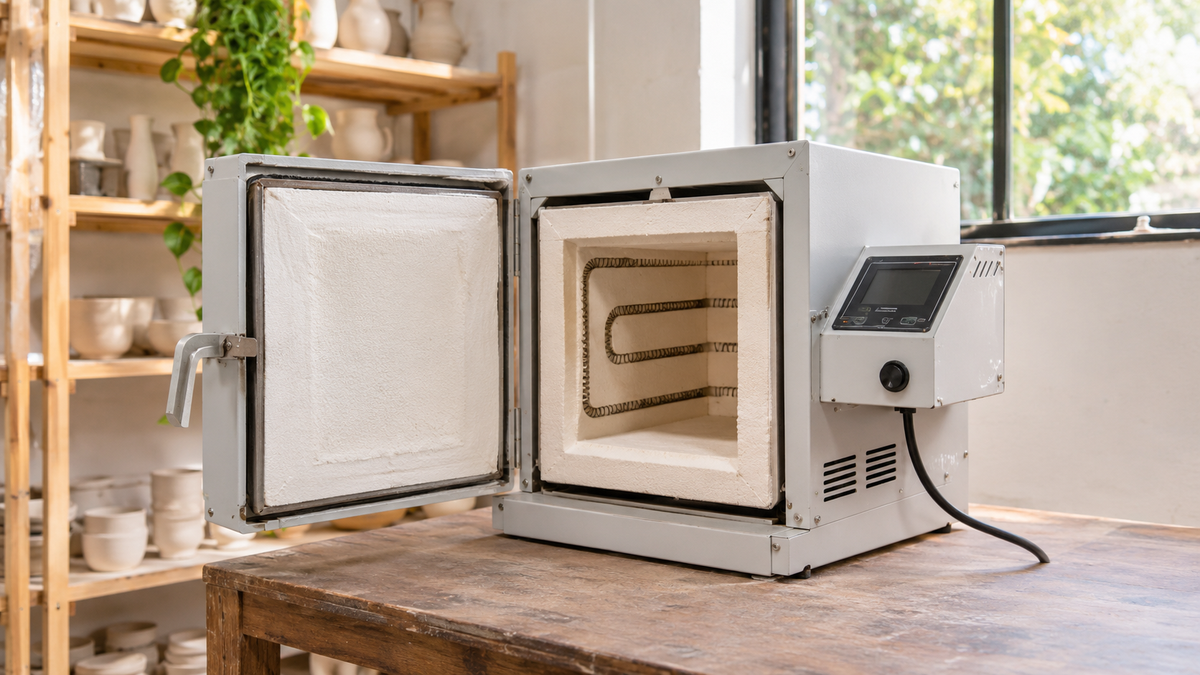
How long do kilns last? A well-maintained kiln can last 30 years or longer when its structure is sound, compatible parts are available, and maintenance stays current. That is a documented possibility, not a typical lifespan or a guarantee. Age alone does not decide whether the kiln should be repaired or replaced.
An electric kiln's lifespan isn't simply a matter of age. Slower heat-up, uneven results, or a missed temperature call for diagnosis and repair evaluation. Those changes do not automatically end the kiln's service life.
Key Takeaways: How Long Kilns Can Last
- An electric kiln's lifespan isn't simply a matter of age. A historical manufacturer record shows that 30-year-old electric kilns were still working, but it does not establish an average or a guarantee.
- Kiln Frog warns against guessing the cause of a repair issue and notes that some part orders require the kiln model and serial number, supporting a model-first repair decision.
- Elements, thermocouples, relays, switches, connectors, and some controller parts can be repairable service items, so one failed component doesn't seal the kiln's fate.
- Declining kiln performance doesn't automatically mean full replacement. Diagnose and fix the issue first using Kiln Academy's The Ultimate Guide to Kilns and Ovens.
- Repair makes more sense when the structure and wiring are sound, compatible parts are available, and the kiln still fits your studio needs.
How Long Do Kilns Last?
An electric kiln has no single expiration date. Workload, peak temperature, long holds, installation, contamination, storage conditions, and maintenance history all affect the pace of wear. If you are asking how long a pottery kiln lasts, compare workload first. A pottery kiln fired near its rating several times a week will last longer than a glass kiln used twice a month at lower temperatures.
Real examples support the 30+ year possibility. A College of DuPage board packet described two ceramics studio kilns that were roughly 40 years old when the college sought replacements. A 1982 industry advertisement also reported 30-year-old electric kilns still working. The second example is a manufacturer self-report, so it should be read as a historical example rather than independent lifespan data.
Together, these records show that older kilns can remain serviceable in studio and industrial settings. They do not establish a typical lifespan for today's electric studio kilns. A qualified condition assessment still matters, especially when the kiln's service history is incomplete.
What Shortens a Kiln's Working Life?
Kiln life can shorten when electrical mismatch, moisture, contamination, poor ventilation, or skipped maintenance creates avoidable wear. Start with firing history, then check the installation and environment.
Firing History Matters More Than Calendar Age
Your firing log gives you a baseline that the manufacture date cannot. Record the target cone or temperature, ramp and hold schedule, total firing time, error codes, repairs, and changes in results. If heat-up time starts creeping longer or one area falls behind, compare the new behavior with the kiln's own past performance.
Performance changes can come from worn elements, a drifting thermocouple, a relay fault, a loose connection, loading changes, or the firing program itself. Find the cause before deciding the kiln is running out of life.
Installation and Environment
Moisture, corrosion, poor ventilation, unstable power, overheated connections, and a supply that does not match the nameplate can shorten working life or create a safety problem. Heavy loads, debris on elements, glaze contamination, and firing beyond the model's rated use add avoidable stress.
The Texas Department of Insurance kiln safety program notes that components differ by model and calls for professional electrical hookups. Use the current manual for the exact model. A general article can help you spot patterns, but the manual sets the electrical, ventilation, maintenance, and operating rules for that kiln.
Will a Replacement Kiln Work With Your Studio's Power?
A replacement kiln must match both the work you plan to fire and the electrical service your studio can support. Kiln Frog's 120V vs. 240V guide explains why chamber size, voltage, amperage, breaker capacity, and outlet type need to line up before you choose a model. Confirm the available service with a qualified electrician, then compare kilns that fit it.
Which Parts Usually Wear Out First?
Elements, thermocouples, mechanical relays, switches, connectors, and some controller parts are service items. Replacing one of them can restore normal operation without sealing the fate of the whole kiln.
When you decide whether to keep the whole kiln, look more closely at the shell, frame, firebrick body, lid or door, wiring, insulation, and signs of widespread heat damage. A solid structure with one diagnosed wear item is a very different case from a warped frame and faults across several systems.
Model Details Needed to Match Parts
Before ordering kiln parts, collect the brand, model, serial number, voltage, phase, and any identifier printed on the failed component. Similar-looking parts can have different ratings. Kiln Frog asks customers to confirm the kiln model and serial number for some part orders. Make that check early in the repair process.
Is Your Kiln Worth Repairing?
An older kiln with a straight frame, sound wiring, manageable brick wear, and documented maintenance may have plenty of working life left. Repair is easier to justify when the problem is isolated, the correct manual and compatible parts are available, and it still fits your studio needs.
Start with a diagnosis before planning kiln repair. Kiln Frog recommends Kiln Academy's The Ultimate Guide to Kilns and Ovens to help you organize symptoms before you call for service. A firing that has grown slower or less even may return to its old baseline after the actual fault is repaired.
Common Repairs That Can Add Years of Service
Slow firings or trouble reaching temperature often put elements on the suspect list. Before planning kiln element replacement, review the signs of worn kiln elements, then follow the exact model manual for testing and replacement. An element set must match the kiln's electrical configuration.
Before planning kiln thermocouple replacement, confirm whether erratic readings start at the thermocouple, its wiring, or the controller. Use the thermocouple troubleshooting guide to arrange the first checks. Before kiln relay replacement, remember that relay symptoms can overlap with element and connection faults. Use the model's wiring diagram and Kiln Frog's kiln relay check before anyone names the culprit.
Localized firebrick damage may be repairable. Depth, location, contamination, and structural movement matter. The kiln brick repair guide explains common damage, but crumbling brick, glaze-soaked insulation, or a shifting structure deserves a professional opinion.
When to Call a Kiln Technician or Electrician
Stop and get qualified help for scorched wiring, melted connectors, a damaged cord or plug, repeated breaker trips, receptacle trouble, control-box faults, or repeated over-temperature behavior. OSHA guidance says a circuit or connected equipment must be examined and repaired by a qualified person after a breaker trips again before it is re-energized.
Disconnect power before inspection or service and follow the exact model procedure. Evenheat's Studio Pro manual directs owners to disconnect power before maintenance and use a licensed electrician for electrical work. Permanent wiring, breaker-panel work, and circuit changes belong to a qualified electrician.
Do not use the kiln again until the fault has been assessed and repaired by a qualified person following the exact model manual. A missing manual, uncertain diagnosis, or lack of proper test equipment is a reason to step back.
When Is It Time to Replace a Kiln?
Kiln replacement becomes a practical option once the problems are no longer isolated. A warped frame, extensive crumbling brick, contaminated insulation, widespread wiring damage, repeat faults across systems, or unavailable parts can make another repair costly and uncertain.
Deciding when to replace a kiln also depends on studio fit. A kiln may still heat but no longer provide the capacity, temperature range, control, uniformity, or production pace your work needs. Review Kiln Frog's kiln electrical requirements before assuming a replacement will use the existing circuit.
Declining firing performance alone does not end a kiln's useful life. Diagnose the change and price the repair. Replacement becomes the better plan when verified safety, structural, support, cost, downtime, or studio-fit concerns add up.
Repair or Replace: Compare Total Cost and Downtime
Use the table below to organize the decision. It does not replace the model manual, electrical testing, or a qualified assessment.
|
Check |
Repair is more likely when |
Replacement is more likely when |
Verify before deciding |
|
Issue scope |
A diagnosed wear item explains the symptom. Slower or uneven firing is investigated before any replacement decision. |
Faults span several systems, keep returning, or cannot be isolated safely. |
Diagnosis, repair history, firing log, and test results |
|
Age and history |
A well-maintained kiln can remain serviceable for 30+ years. An older kiln with a straight frame, sound wiring, manageable brick wear, and documented maintenance may have plenty of working life left. |
Calendar age alone never settles the decision. Replacement needs other verified concerns. |
Maintenance records, condition, serviceability, and qualified assessment |
|
Structure |
Frame, shell, lid or door, and brick remain stable and repairable. |
Frame is warped, brick is crumbling, or insulation is contaminated across a wide area. |
Whether damage is local, stable, and repairable |
|
Parts support |
The correct manual and compatible parts are available. |
Parts are unavailable or compatibility cannot be confirmed. |
Brand, model, serial number, voltage, phase, and part ID |
|
Studio fit |
After repair, it still fits your studio needs. |
Capacity, temperature, control, uniformity, or electrical needs have outgrown it. |
Current workload and near-term plans |
|
Safety |
A qualified assessment identifies a safe, model-specific repair. |
Unsafe conditions remain unresolved or safe restoration cannot be verified. |
Manual, qualified inspection, and post-repair checks |
|
Complete cost |
Parts, labor, electrical work, and shipping remain reasonable for the service expected. |
Repeat repairs and installation work approach the delivered cost of a suitable replacement. |
Written quotes and expected service after repair |
|
Downtime |
Parts and service are available within an acceptable schedule. |
Repeated outages or uncertain lead times threaten the studio's work. |
Parts lead time, technician schedule, freight, and production loss |
Skip universal percentage rules. Add the repair parts, labor, electrical work, shipping, production loss, and expected downtime. Compare that total with the fully delivered replacement kiln cost, required installation changes, and the value of better capacity or control. Kiln Frog's kiln pricing guide can help you build the replacement side of the comparison.
Then picture the kiln after the proposed repair. Will its other major systems remain serviceable, and can you still get the correct parts and technical support? Will the repair return the kiln to the workload you actually need? Write the answers down before a deadline turns the choice into a rushed one.
How to Make a Kiln Last Longer
A model-specific kiln maintenance checklist helps prevent avoidable damage and makes slow changes easier to catch. The current manufacturer's manual should set the schedule.
- Inspect the chamber, brick, lid or door, elements, thermocouple, cord, plug, and visible connections before firing.
- Clean only after the kiln is cold and disconnected. Follow the manual's dust-control method.
- Keep glaze, glass, shelf debris, and broken work away from elements and insulation.
- Log schedules, results, error codes, maintenance, and repairs. UMass Dartmouth's ceramics safety guidance also requires a kiln log in its studio procedures.
- Use witness cones or model diagnostics when they suit the process and the manual.
- Store the current manual, wiring diagram, service history, nameplate details, and model-specific part records together.
For one practical example, the Evenheat manual calls for periodic inspection, careful HEPA-filtered vacuuming, and power disconnection before maintenance. Apply only the instructions written for your model. A generic calendar cannot account for every kiln's design and workload.
What Should You Compare Before Replacing a Kiln?
Before replacing a kiln, compare chamber shape, shelf size, depth, temperature range, controls, power needs, and the work you expect to make next. Kiln Frog's kiln size and shape guide recommends choosing around the largest projects you plan to fire, then checking how depth and chamber volume affect power needs. This check separates a repairable kiln that still fits from one your studio has outgrown.
How to Evaluate a Used Kiln
Start with the nameplate. Confirm the model, serial number, voltage, phase, amperage, plug or hardwiring requirements, current manual, and parts support before talking price. An incompatible kiln can turn a tempting purchase into a large electrical project.
Inspect the firebrick, lid or door alignment, elements, thermocouple, wiring, connectors, controller, jacket, corrosion, and repair history. Ask how often it fired, at what temperatures, and why the owner is selling. Treat unknown history as a reason for a deeper review. Keep the same safety standard.
A test fire makes sense only after the manual and a qualified assessor confirm the kiln is safe to energize. If that review or a supervised test is unavailable, price the kiln as equipment that still needs diagnosis and likely service. Never improvise an electrical test just to close a sale.
Get Model-Specific Help from Kiln Frog
An electric kiln's lifespan isn't simply a matter of age. A well-maintained kiln can last 30 years or longer, and older units still work in studios and industry. Condition, repairability, parts support, safety, and whether it still fits your studio needs matter far more than the date on the nameplate.
If firing performance changes, diagnose the cause before deciding to replace the kiln. Send Kiln Frog the brand, model, serial number, voltage, phase, symptoms, and recent firing history. The team can help narrow the search to a compatible part or a replacement electric kiln that fits your work and electrical setup.
For replacement kilns in the contiguous United States, Kiln Frog's delivered-price terms include standard shipping and residential lift-gate delivery. Addresses that a lift-gate truck or commercial vehicle cannot reach may carry extra charges. If replacement is the right fit, use the pottery kiln buying guide to compare models by craft, capacity, temperature, and electrical needs.


