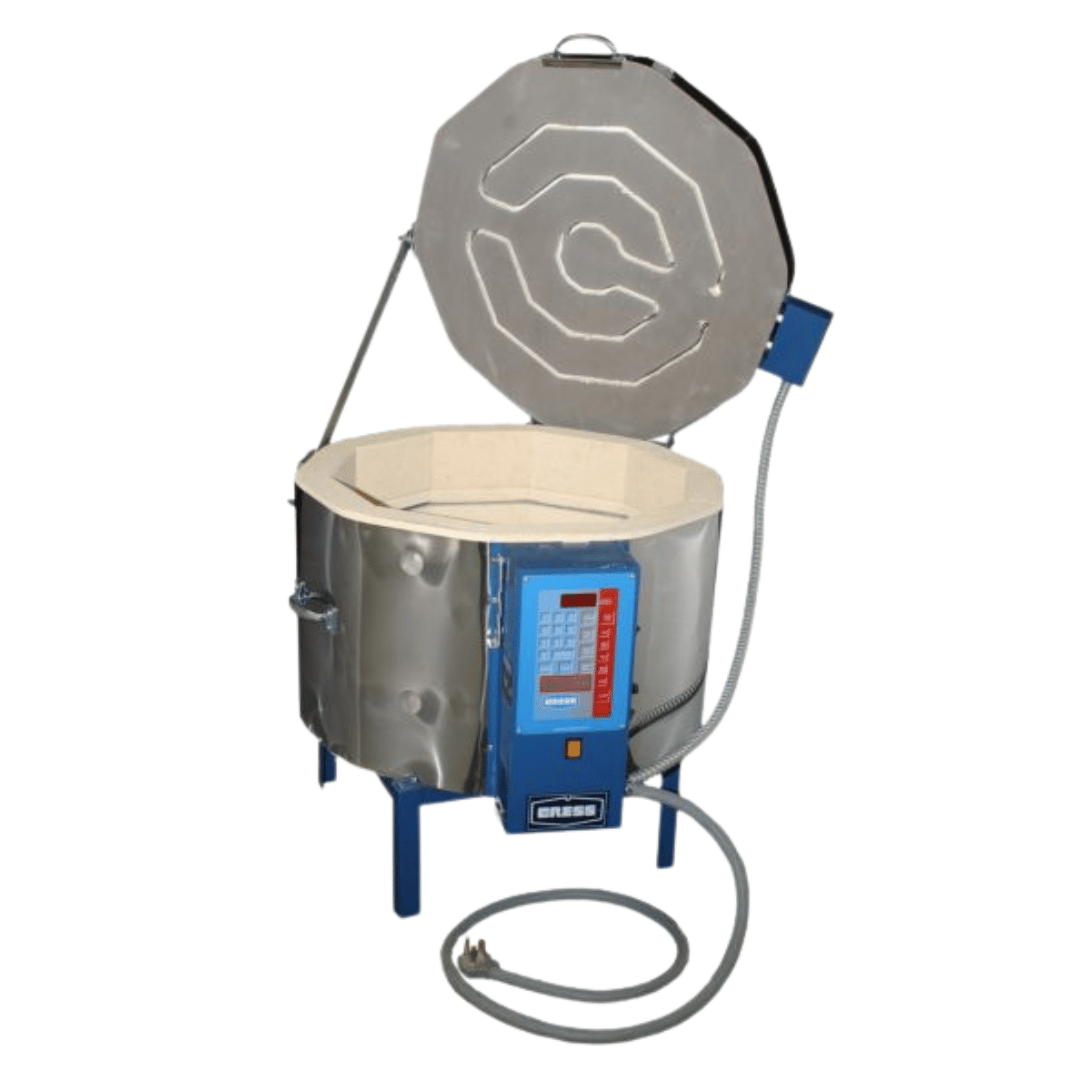
Cress Kilns - FUSER2414E

Cress Kilns - FUSER2414E - Kiln Frog
Cress Kilns - FUSER2818 - Kiln Frog
Jen-Ken Kiln - AFG 2815-E - Kiln Frog
Jen-Ken Kiln - ProFusion Fiber 15 "Bonnie Glo" Tall - Kiln Frog
Cress Kilns - FUSER89E - Kiln Frog
Temperature Down
Temperature
Uniformity
Shield Mark
Highest Quality
Heating Elements
Lower Cost
Cost-Effective
Maintenance
Payment & Security
  • American Express
  • Apple Pay
  • Diners Club
  • Discover
  • Google Pay
  • Mastercard
  • PayPal
  • Shop Pay
  • Visa

Your payment information is processed securely. We do not store credit card details nor have access to your credit card information.

Cress Kilns - FUSER2414E

$ 2,643.84 Regular price $ 2,754.00 Sale priceSave 4%
/
  • Post Purchase Customer Service
  • Lifetime Technical Support
  • Ongoing Educational Resources
  • Best Price Promise
  • Most Kilns Ship FREE in the US 48*
  • Secure Checkout & Payments
  • Need help?
  • Schedule a call with our expert Call Now
PRODUCT DESCRIPTION

This kiln is equipped with a full size keypad capable of doing cone fire firings, holds 6 programs with 8 segments each, and comes preset with six Ramp-Hold programs, glass slumping, glass tack, glass full fuse, glass bead-annealing, lost-wax burnout, and slow cooling cycle.

Product Specifications
Model: Cress Kilns - FUSER2414E
Inside Dim: 23.38" Dec. (width) x 13.5" (depth)
Outside Dim: 22.5" (depth) x 29.5" (width) x 27.4" (height)
Brick Thickness: 2.5" in
Max Temp: 2000°F, Cone 3
Voltage: 240V / 208V
Current/Amperage: 36 A / 31 A
Power/Kilowatts: 8.64 kW / 6.5 kW
Amp Fuse Size: 40
Short Wire Size: 6
Receptacle:
6-50R
Shipping Weight: 225# (Motor Freight)


What's Included
  • FREE SHIPPING in the contiguous US!
  • Full Size 12-Key Controller
  • LED Readout Display
  • Peephole & Peephole Plugs
  • Heavy Gage Elements
  • Steel Base Plate
  • Instruction Manual
  • 3-Year Limited Warranty (The manufacturer's warranty as well as the optional add-on Extended Warranty Protection Plan do not cover a service contractor to provide in-home kiln repairs.)
Key Information

Steel Base Plate: A steel base plate is included for safety and strength.
Tapered Peepholes & Peephole Plugs: Tapered peepholes offer a wider angle of viewing into the firing chamber and the snug fitting; tapered firebrick plugs minimize heat loss.

Elements & Element Grooves: Cress kilns use the highest quality most durable elements set into precision cut grooves. We take the extra time and expense to pin our elements in place closer to the firing chamber, taking advantage of direct radiant heat and increasing element life.

Exceptionally Mechanically Sound: The strong steel fixed hinge provides a strong, steady attachment of the lid to the kiln and avoids the problem of possible damage by brick hitting brick near the joint. We use a superior extra strong lid brace for extra safety. The rigid back brace clamps keep the kiln strong over the years helping protect the brick and giving the kiln a strong spine. A strong pre-assembled welded steel stand is standard.

Instruction Manual: An excellent and concise instruction manual, click here to download the manual and read more on these glass kilns.

Warranty Benefits
Enjoy Peace of Mind
Simple, hassle-free product protection for the products you love.
Protection Plan Coverage & Benefits

Frequently Asked Questions:

All About Kilns
What other features are important?
Kilns from every manufacturer are configured with features that allow for different types of functions. These features are available in fiber and brick models. Consider these options:

Top Load Kilns: Ideal for jewelry makers and projects involving powders and frit. Provides good visibility but may be challenging if you’re looking for a deeper kiln or have shorter arms.

Front Load Kilns: Suitable for tasks like enameling and hot manipulations. Offers control and less direct heat, but can be more expensive and require some lifting. This is also true for the weight on the shelf and placing it in front of you.

Clam Shell Kilns: Combines top and front loading, these types of kilns really delivers the best of both worlds; accessibility and free access to your shelf, in addition to ease of loading, and convenience, but may come at a higher cost.

Flip Doors (aka; Punty Doors, Bead Doors, Doggie Doors): Essential for preheating rods and quick bead placement. However, they may affect efficiency and temperature reach.

Windows (aka; quartz portholes): These are not the same as vent holes or peep holes. Optional quartz portholes for monitoring projects at peak temperatures, especially helpful for slumping, draping, or drop ring project. A window will also allow you to check the progress of a pot melt/aperture pour or screen melt.
What to consider when buying a kiln?
What kind of projects would you like to do?

The type, size, and kiln features you require are determined by the projects you choose. This covers things like firing techniques, loading systems, building components, voltage, controllers, and more. Your response may help to clarify your preferences, but you should also consider how well your preferences match with your current circumstances.

Where will you be locating the kiln?
The kind, dimension, and features of your kiln are influenced by where it is. Environment, power supply, safety, and space availability are all important considerations. Your desires might not always line up perfectly with the constraints of your surroundings, this is where we as artists must become creative problem solvers in an effort to overcome our environmental constraints.

We're here to support you. Please reach out if you need any additional advice!

Where should I place my kiln?
Here are some basic guidelines about locating your kiln:

  • Make sure you have adequate space... at least 12 - 18 inches of space between the kiln and the wall. (However, for operator comfort, allow room to walk around the kiln if maintenance is required.) It is recommended that the unit be placed on a stand on top of flame-resistant flooring like a cement floor or board.
  • Make sure the area is really clean - remove all flammable or combustible materials such as curtains, plastics, rags, paper, packing materials, etc. from the area surrounding the kiln.
  • Make sure the area is well ventilated – proper air exchange is necessary for you kiln to last a long time. Heat from the kiln and outside air can accumulate in restricted areas above both gas and electric kilns.
  • Make sure that the heat has somewhere to go, and is replaced by fresh cooler air. Set up a fan near the area, or open a window to ensure good air exchange. Check all local requirements or codes before installation.

  • IMPORTANT: Always read your owners manual and follow you kiln manufacturer's instructions.
Plugs & Electricity
What type of plug do I need?
Each kiln model described on our website will identify which of the following power supply receptacles is used with that model. They are identified by voltage and amperage as well as the NEMA designation. Those described as "direct wire" do not use a receptacle, instead, they are permanently wired.
Maintenance
Care and Maintenance
Proper kiln maintenance is essential for preventing downtime and costly repairs. Here's a checklist to help you keep your kiln in top shape:

Before Every Firing:
  • Inspect: Check inside your kiln for any unwanted visitors, moisture, or debris. Ensure your pet-friendly area is clean to prevent odorous surprises.
  • Vacuum: Turn off the power and use a vacuum with a HEPA filter to clean the interior, removing dust and residue that could affect your glass during firing.
  • Clean: Remove flammable materials from the area around the kiln.
  • Inspect Elements: Ensure coils/elements are in place, free of debris, and securely fastened. Check thermocouples and tighten lid screws as needed.
  • Check for Cracks: Examine your shelf for cracks and address them to prevent issues during firing.
  • Power Up: Turn the power back on and ensure the kiln registers the correct room temperature.
Monthly Maintenance:
  • Lid Check Up: Periodically tighten the lid band as the lid expands and contracts during firings. Most kiln lids are manufactured with a protective coating on the "hot side" or inside. This coating was applied to optimize the heat insulation of the lid, as well as to prevent brick dust from falling into the kiln. Address cosmetic lid cracks, and for structural issues, consult the manufacturer during the warranty period. If you are in the warranty period, DO NOT ATTEMPT TO REPAIR THIS without calling the manufacturer, as this could void your warranty.
  • Body Check Up: The only things inside of your kiln should be your elements, pins, brick, kiln furniture/posts and kiln washed shelves. Remove any non-essential materials such as (glaze, slip, clay, glass, silica sand) from the sidewalls to protect them and the heating elements. Be cautious when using kiln cement to repair cracks, and contact the manufacturer if needed during the warranty period. If you are in the warranty period, DO NOT ATTEMPT TO REPAIR THIS without calling the manufacturer, as this could void your warranty.
  • Inspect Elements: Look for signs of wear such as rust, bulging, or thinning/thickening areas. Elements wear out with usage and may need replacement. If you find it necessary to change out your elements, make sure you speak to the manufacturer to determine the appropriate element size for your kiln. Please refer to your operator’s manual for the discussion and photo's of "Element Replacement".
  • Electrical Check Up: Regularly examine the power cable, receptacle, and plug for discoloration, heat, corrosion, or loose connections. Address any electrical issues promptly, and consult the manufacturer if needed, especially during the warranty period. If you are in the warranty period, DO NOT ATTEMPT TO REPAIR THIS without calling the manufacturer, as this could void your warranty.

Regular maintenance will help your kiln perform efficiently and extend its lifespan.
What are Safety Precautions?
Kilns are as safe as any other electrical appliance when used under normal and proper operating conditions. All kiln safety precautions should always be observed.
  • Use common sense while installing and using your kiln.
  • Do not install your kiln closer than 12" from any surface, or closer than 18” from a combustible surface. Remove all potentially combustible materials from the kiln area.
  • Make sure all electrical specifications are followed. Use correct voltage, wire size and circuit breaker. Make sure all connections are tight. Avoid using aluminum wire. Always use the proper grounded receptacle. A qualified electrician or service person should be used for all electrical service or repairs.
  • Install in covered, walled in, well-ventilated area. Fumes from the ware should be vented to the outside.
  • Avoid moisture. Do not allow your kiln to get wet. Never use your kiln outside!
  • Always keep children and unsupervised personnel away. Surface will get hot and a burn could result.
  • Fire glass only to the manufacturers recommended firing temperature. Improper fire temperatures could result in damage to your kiln. Do not operate glass kilns over the maximum temperature rating.
  • Replace any worn or defective parts with ONLY genuine replacement parts.
  • Unplug kiln when not in use and if there is an electrical storm.
  • Unplug the kiln before servicing or vacuuming.
  • Do not drop or slam the lid shut.
  • Let the kiln cool to room temperature before opening the lid.
Cress Kilns - FUSER2414E | Kiln Frog